The Development of the Red Swastika Society (世界紅卍字會)
The World Red Swastika Society (世界紅卍字會) is the most important public charitable organization within the Daoyuan (道院) system. When modern readers see the character 卍, they may immediately think of twentieth-century European fascism. But in the context of Chinese religion and East Asian Buddhism, 卍 has been a symbol of auspiciousness, light, merit, and salvation for over a millennium. To understand the Red Swastika Society, one must first place it within the history of charity and religious associations in Republican China — a landscape more diverse and institutionally sophisticated than conventional narratives of Chinese modernization usually acknowledge.
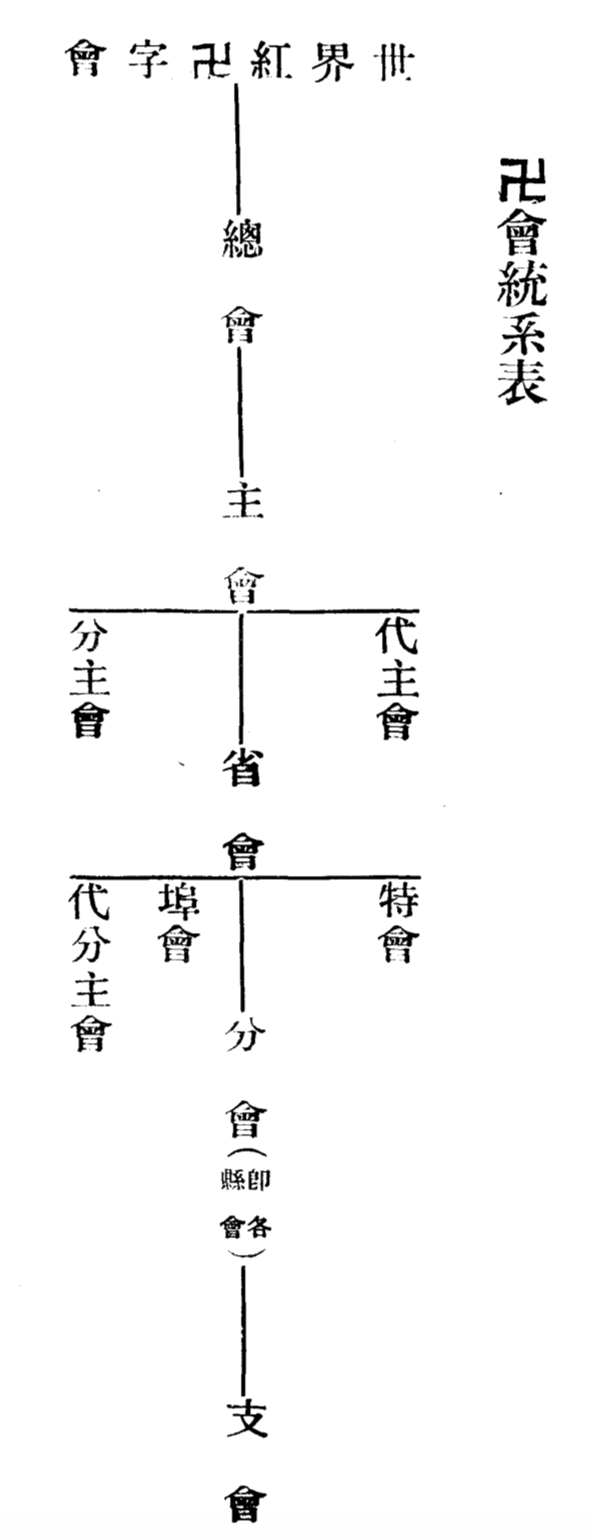
The Relationship with Daoyuan
The Red Swastika Society is not an organization entirely separate from Daoyuan. Daoyuan materials commonly use the concept of "substance and function" (體用, ti-yong) to explain the relationship: Daoyuan is the substance (體, ti), and the Red Swastika Society is the function (用, yong). Daoyuan leans toward self-cultivation, spirit-writing, and moral inquiry; the Red Swastika Society leans toward relief, charity, and social action.
This relationship can be understood in simple terms: Daoyuan explains why one should perform good deeds, and the Red Swastika Society organizes those good deeds into public undertakings. Daoyuan's altar instructions and moral discourse provide mobilizing force, while the Red Swastika Society converts that force into disaster relief, medical care, shelter, welfare, and local public services. The historian Li Guangwei has shown how this worked in practice: during the 1929 Northwest China famine, Daoyuan deities exhorted members through spirit-writing "like parents urging their children," framing charitable donations as a direct response to sacred instruction — not merely social obligation but a component of religious practice itself.
Why Republican China Needed Such an Organization
The social environment of the early Republic was far from stable. Warfare, famine, regional fragmentation, refugee flows, and insufficient public finance meant that charitable organizations performed many practical functions that the state could not. Official relief capacity was limited; local gentry, merchants, religious groups, and civic associations often had to participate collectively. This is the environment in which the Red Swastika Society grew.
To appreciate the scale of this charitable landscape, consider Shanghai. Before the 1911 Revolution, the city had roughly 40 charitable organizations. By 1930, that number had grown to 118. Many of these were deeply connected to spirit-writing culture. The influential Zhongguo Jishenghui (中國濟生會), founded in Shanghai in 1917 around a Jigong (濟公) spirit-writing altar, collected over 200,000 dollars for relief within its first year and attracted over 1,000 disciples. Even earlier, during the Boxer War of 1900, spirit-writing instructions from Jigong had ordered relief operations that led to the founding of the Jiuji Shanhui (救濟善會), which historian Wang Chien-chuan argues was the institutional precursor to the Chinese Red Cross. The Red Swastika Society emerged into a world where charity and spirit-writing were already intimately linked — and it scaled that link to a national level.
The Red Swastika Society was unlike traditional lineage-based charity, which served only a single locality or kinship group, and unlike a purely religious altar, which handled only matters of belief. It sought to build a transregional branch network and to handle famine relief and social assistance under a unified organizational identity.
The Deeper Roots of Spirit-Writing Charity
The connection between spirit-writing and organized charity predates the Republic by several decades. Wang Chien-chuan traces one important lineage to the Guandi revelations at Longnüsi temple in Sichuan around 1840. These revelations, which produced influential morality texts such as the Jiushengchuan (救生船, "Boat of Salvation," 1860), directly led to the establishment of the Shiquanhui (十全會) charity society in 1866. The Shiquanhui spread throughout eastern and northern Sichuan, using Guandi as its patron deity, and later reached Xikang (Kangding) in 1901–1902 through Confucian altars (儒壇). By the time Daoyuan was founded in 1921, there was already a well-established tradition of spirit-writing organizations operating charitable enterprises — the Red Swastika Society did not invent this model, but it brought it to unprecedented scale.
The Red Swastika Society also drew on the Jigong cult, which was particularly strong in Hangzhou and Shanghai. Daoyuan adopted Jigong as a main deity in charge of the "charitable mission" (慈院). During the massive floods of 1935, the Wuxi Daoyuan organized joint rituals with the prominent Buddhist reformer Taixu (太虛), and Jigong intervened through spirit-writing to direct relief efforts.
From Local Charity to a Transregional Network
Daoyuan and the Red Swastika Society expanded rapidly. Records show that by the early 1920s, related branches had already spread from Shandong to North China, East China, the Northeast, and the Yangzi River basin, and connections were being made with Japan, Korea, and Singapore. This was not a Jinan local organization — it was a genuinely transregional network.
This network-based development depended on several resources. The first was Daoyuan's internal religious cohesion — shared rituals, texts, and divine instructions created bonds across geographic distance. The second was the charitable legitimacy of the Red Swastika Society: in an era when the state could not meet basic welfare needs, an organization that delivered concrete relief earned public trust. The third was the participation of local elites, merchants, and social notables who brought resources and connections. The fourth was the system of publications and conferences, which enabled branches to share news, divine instructions, and organizational experience across provinces.
Charity as Religious Practice
The charity of the Red Swastika Society was not merely "doing good deeds." In the Daoyuan system, charity and self-cultivation are linked. Spirit-written instructions frequently urge people not merely to seek divine protection for themselves, but to accumulate merit (功行, gongxing) through self-cultivation, donations, disaster relief, and helping others. In other words, charity is part of religious practice.
This is also why the Red Swastika Society was able to mobilize resources. For members, providing relief to disaster victims, raising funds, and participating in public aid were not only social services — they were ways of practicing morality and responding to divine instruction. The emotional force of receiving a direct message from a deity, delivered through a stylus held by fellow members, created a motivational structure that bureaucratic charity could not replicate.
The Symbol Question
When presenting the Red Swastika Society today, the symbol must be explained. 卍 is an ancient auspicious symbol in the Chinese and Buddhist traditions; "red swastika" (紅卍) here signifies relief, charity, and a cosmopolitan vision. Its original meaning cannot be overwritten by later European political symbolism — the Nazi Hakenkreuz and the Buddhist 卍 are historically unrelated, oriented differently in their standard forms, and belong to entirely separate symbolic universes.
At the same time, one cannot pretend that modern readers have no questions. The responsible approach is to state directly: the historical name "Red Swastika Society" is retained to respect the organization's self-designation; the symbol's meaning is defined by the context of Chinese religious charity in the Republican period; and it does not share a historical origin with the Nazi emblem.
The Three-Layer Story
The Red Swastika Society is best understood through three layers. The first is institutional history: how it developed out of the Daoyuan system, continuing a much older tradition of spirit-writing charities that reached back to the mid-nineteenth century. The second is spatial history: how its branches were established in localities across China (and beyond), forming a relief network that could move resources across provincial boundaries. The third is practice history: how charity became a form of religious practice, how divine instructions mobilized donors, and how the boundary between "social service" and "responding to the gods" dissolved in the daily operations of shelters, clinics, and relief stations.
The Red Swastika Society is therefore not an auxiliary of Daoyuan. It is the crucial bridge through which a religious community entered public society — and one of the most significant experiments in organized, religiously motivated charity in modern Chinese history.